← Browse all speaker resources
All Things AI · Sponsor resources
How to Give a Sponsored AI Talk That Wows
Educate. Inspire. Give people a reason to want the next conversation.
Here's what I want someone to say when they leave your session: “I learned something. I can see how this could help us. I want to meet the people behind it.”
You have our attention. Show us a problem worth solving, a possibility worth exploring, and the work that makes it real. Let us see what your team knows and why you're excited to share it.
The quick answer
A strong sponsored AI talk helps the audience solve a real problem, understand a useful possibility, and decide what to explore next. Teach the idea, demonstrate one complete task, explain the evidence and limits, and offer a relevant next step. Let attendees experience your expertise through the value of the session.
Talk examples from our archives
Watch these talks with a specific question in mind: what could you learn from the way the speaker connects an idea to the audience? The notes below offer starting points for your own preparation.

Teach the idea, then show the product
Don’t just talk to AI, do more with AI: How to improve productivity with AI agents
Sheng Liang · All Things AI 2025
Sheng explains instructions, knowledge, memory, tools, and workflows before introducing Obot. At 8:16, he moves from those concepts into a product walkthrough. The audience has a framework for understanding what the demonstration is meant to show.
Try this in your talk: Before opening your product, explain the problem and the ideas the audience needs to understand it. Then connect each important step of the demo to that explanation.
Connect expertise, personality, and possibility
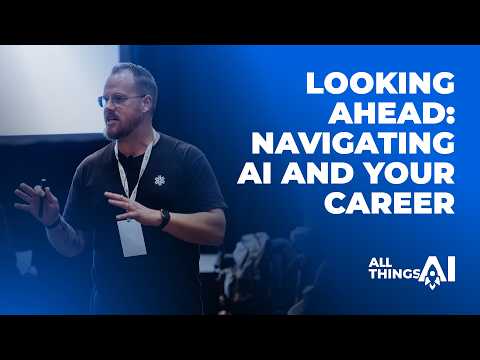
Looking Ahead: Navigating AI and Your Career
Taylor Desseyn · All Things AI 2026
Taylor makes AI relevant to a concern people bring into the room: their careers. His published slides introduce both his professional experience and the person behind it, then move toward encouragement and practical ways to get started.
Try this in your talk: Name the concern your audience feels, share enough of yourself to make a connection, and leave them with a first step they can imagine taking. Study slides 2 and 9 alongside the recording.
What does “wow” actually mean?
Give us a moment when a possibility becomes clear. Show something useful we hadn't considered, explain how it works, and help us imagine applying it to our own work.
Tell us what made you pursue the problem. What surprised you? What changed your thinking? Let your curiosity and personality come through. Then give the audience a way to explore the idea themselves.
Research connection: Thrash and Elliot's research distinguishes being inspired by something from being inspired to do something. Our application is to connect the possibility you reveal with an action the audience can imagine taking. Thrash and Elliot, 2004.
How much should I talk about our company and product?
Be clear about who you represent and that this is a sponsored session. Give us the background we need to understand your expertise, then bring us into the problem.
Show your product where it helps explain the solution. Walk through the choices behind it, the tradeoffs, and what you've learned. Give people a useful lesson they can take away even if they never become a customer.
What the buyer research says: In the 2024 Edelman–LinkedIn report, 73% of B2B decision-makers said thought-leadership content was a more trustworthy basis for assessing an organization's capabilities than its marketing materials and product sheets. The study surveyed 3,484 business executives through LinkedIn across seven countries in late 2023. This is a commercial survey of reported attitudes, not evidence that a particular talk will generate sales. Edelman and LinkedIn, 2024, pp. 5 and 8.
What topic should we choose?
Choose one problem the people in the room recognize and one outcome you can help them understand. Tell them who the session is for and what they'll leave able and eager to do.
For example, a session could explore “How to evaluate an AI answer before it reaches a customer” or “Where human review belongs in an automated document workflow.” These are illustrative topics; build your talk around work you can actually show.
Choose a presenter who knows that work well enough to answer questions about it. A builder, practitioner, or customer with a story they're willing and authorized to share can bring the decisions to life.
From the All Things AI archives
Make a connection worth continuing
The product gets more interesting when the audience understands the problem it can help them solve.


How do we build a demo worth watching?
Take us through one complete task. Before you start clicking, tell us what success would look like.
- Set the scene. Who needs this done? What do they start with? Where is the difficulty?
- Show the change. Make the input, the important steps, and the result visible. Explain what the AI does and where a person still contributes.
- Check the result. Show how you judge quality, what can go wrong, and how you handle it. Explain the conditions needed to reproduce the result.
Use a readable screen and narrate what matters. Label synthetic or sample data. Say whether the demonstration is live, recorded, or a selected example. Rehearse in the allotted time and have a clearly labeled recording or screenshots ready if the connection fails.
Make the result impressive enough to spark curiosity and the explanation clear enough that someone can question it.
What proof should we bring?
Show us the data behind the decision. If you claim an improvement, explain what you compared, how many tasks or people you measured, over what period, and how you checked quality. Include meaningful failures and human review time.
For AI results, identify the model or tool version, relevant configuration, test data, and evaluation criteria. Distinguish a measured result from an estimate, a selected example, or a future capability. Cite original sources beside the claims and provide full links in the shared materials.
A useful reporting framework: Model Cards for Model Reporting proposes documenting intended uses, evaluation procedures, performance under different conditions, and limitations. We apply that transparency principle here so attendees can judge what a demonstration establishes. Mitchell and colleagues, 2019.
If a customer story is part of the talk, explain the customer's context and your company's role. Be precise about what you know. “Here's what worked in this setting, and here's what we still need to test” gives us something useful to discuss.
How do we make the audience part of it?
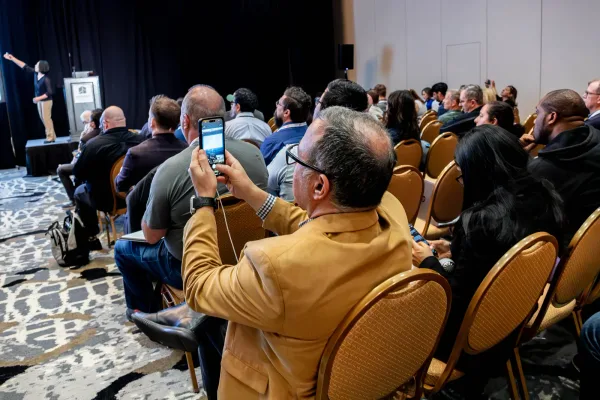
Ask people to think through a choice your team faced. What would they measure? Which output would they trust? Where would they put a review step? Give them a moment to decide before you explain your approach.
The learning evidence: A meta-analysis of 225 undergraduate STEM studies found improved performance with active learning compared with traditional lecturing. That supports giving learners meaningful work to do; the specific activity here is our suggested application. Freeman and colleagues, 2014.
Make participation possible without a phone or a public answer. Invite people to connect the example to a problem they care about. Their questions can help you understand what deserves a deeper conversation.
What could a 25-minute session look like?
This editorial example uses a 25-minute session, including five minutes for questions. Confirm the format with the organizer and rehearse the transitions within these time blocks.
- 0–2 minutes: Introduce yourself and the sponsorship. Open with the audience's problem and the possibility you'll explore.
- 2–5 minutes: Teach the central idea and the decision behind your approach.
- 5–13 minutes: Demonstrate one task, check the result, and explain the evidence and limits.
- 13–18 minutes: Let the audience apply the idea to a choice or example, then discuss it.
- 18–23 minutes: Take questions and explore where the approach fits.
- 23–25 minutes: Return to the possibility, name the practical takeaway, and offer one clear next step.

How should we invite people to continue?
Make the invitation an extension of the value you just delivered. Offer a checklist, the evaluation method, a sample workflow, or a deeper demonstration. Give people a specific reason to meet your team.
An example invitation: “Bring us a workflow you're considering. We'll walk through the questions we'd ask before automating it.” Use an invitation your team is prepared to fulfill.
Show a short URL alongside the QR code. Make the destination and any requested information clear. Let attendees choose whether they want a sales conversation. Brief the team handling follow-up so they can pick up where the talk ended.
How will we know it worked?
Decide beforehand what you want to learn. Check whether people can apply the idea, what they now want to explore, and whether they choose a next step.
Keep those measures distinct. A resource visit, an opted-in conversation about a relevant problem, a meeting, and a business opportunity tell you different things. Record the follow-up period and how you attribute an outcome to the session.
Bring the talk back to a possibility people care about. Help them understand it, evaluate it, and see themselves taking the next step.
Make people glad they gave you their time. Give them a reason to give you more.
Research and sources
- Thrash, T. M., & Elliot, A. J. (2004). Inspiration: Core Characteristics, Component Processes, Antecedents, and Function. Journal of Personality and Social Psychology, 87(6), 957–973.
- Edelman & LinkedIn (2024). 2024 B2B Thought Leadership Impact Report. Methodology: p. 5; trust comparison: p. 8.
- Mitchell, M., et al. (2019). Model Cards for Model Reporting. Proceedings of the Conference on Fairness, Accountability, and Transparency, 220–229. Preprint first posted in 2018.
- Freeman, S., et al. (2014). Active learning increases student performance in science, engineering, and mathematics. PNAS, 111(23), 8410–8415.
A coach for your own material
Make your next talk better
Bring what you have. These AI coaches help you see what is working, what could be stronger, and what to try next. Keep your voice. Find the format that serves your audience.
Sponsored AI Talk Coach
Make your expertise useful to the room. Improve the story, product explanation, evidence, or demo, and give people a reason to continue the conversation.
Download the coaching instructions and add them to a conversation with your AI assistant, along with your draft or the part you want help with. Ask it to follow the instructions. For an app that supports installable skills, use the skill ZIP instead.
Try asking: “Use this coach to critique my material. Help me educate, inspire, and connect with this audience. Explain the most useful improvements and offer examples in my voice. Ask me about anything important that is missing.”